
Leading Beyond the Office: Why Your Biggest Innovation Opportunities Lie Across the Boundary
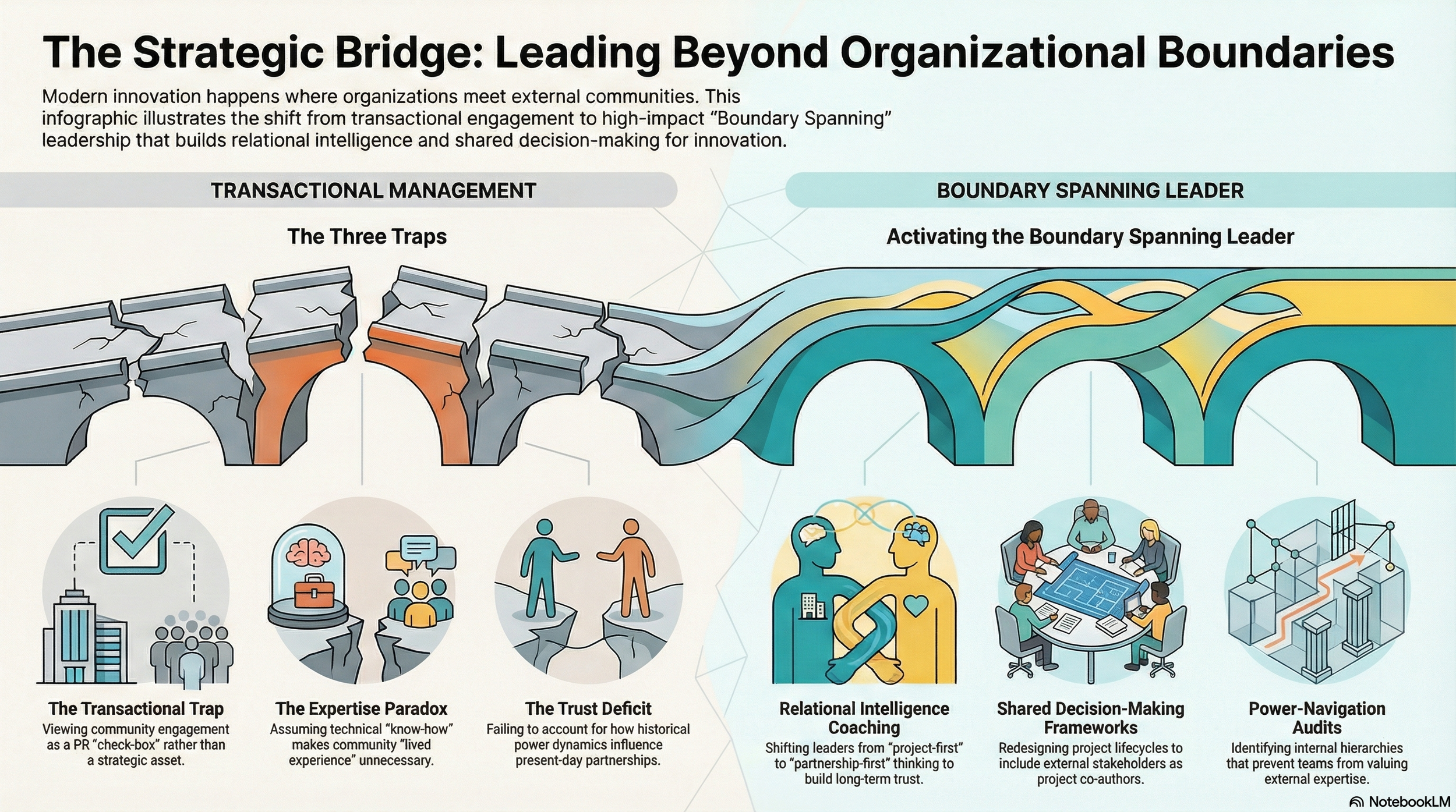
In today’s interconnected economy, no organization is an island. Whether you are a corporate firm navigating local regulations, a researcher conducting field-work, or a film production studio working in a sensitive location, your success depends on your ability to partner with people outside your walls.
Yet, most organizations approach these partnerships as a series of transactions. They treat communities as stakeholders to be managed rather than collaborators to be integrated. This approach doesn't just damage trust—it hinders innovation.
In my research on high-stakes collaborative environments, I’ve found that the most successful projects aren’t led by top-down managers, but by Boundary Spanners.
What is a Boundary Spanner?
A Boundary Spanner is a leader who possesses the relational intelligence to navigate the space between their organization’s internal goals and the community’s external needs. They don’t just deliver a project; they build a bridge.
My research indicates that organizations without Boundary Spanning capacity often fall into three traps:
The Transactional Trap: Viewing community engagement as a check-box for PR rather than a strategic asset.
The Expertise Paradox: Assuming that because you have the technical or creative know-how, you don’t need the community’s lived experience.
The Trust Deficit: Failing to realize that historical power dynamics influence present-day partnerships. If you don't account for the past, you can't build for the future.
Building Your Strategic Bridge
At Transformative Organizational Strategy (TOS), I help you move from surface-level engagement to Stakeholder-Integrated Operations. I train your leaders to be the architects of authentic, high-impact partnerships.
How TOS activates Boundary Spanning in your organization:
Relational Intelligence Coaching: TOS moves your leaders from project-first to partnership-first thinking, teaching them how to build the trust necessary for long-term engagement.
Shared Decision-Making Frameworks: TOS helps you redesign your project lifecycles to include external stakeholders as co-authors, ensuring faster buy-in and fewer roadblocks.
Power-Navigation Audits: TOS identifies where internal hierarchies are preventing your team from seeing the value in external expertise.
The Bottom Line
The most innovative ideas of the next decade won't come from a closed board room; they will come from the boundaries where different worlds meet. To capture that value, you need leaders who know how to bridge the gap.
Read more about the research behind this Case Study:
Are you ready to collectively lead across the boundary?