
Is Your Strategic Plan Actually Shielding You from Change?
In the academic, corporate and creative worlds, a Strategic Plan is often seen as the ultimate proof of commitment. We spend months drafting them, holding focus groups, and polishing the language until it sounds perfect.
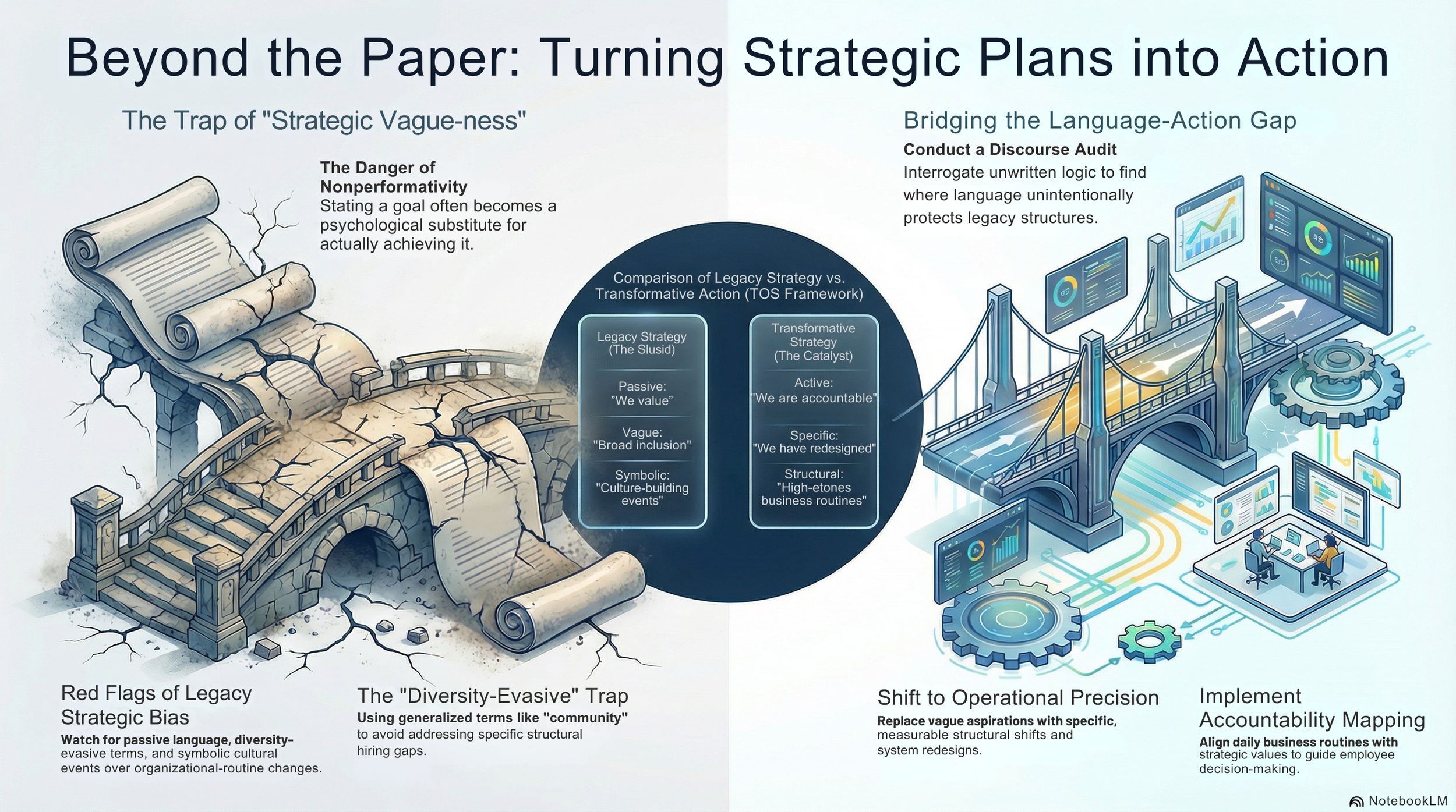
But for many organizations, the plan itself becomes the finish line. Once the document is published, the urgency fades. This is what research calls Nonperformativity—the act of stating a goal as a substitute for achieving it.
The Danger of Symbolic Strategy
In my study of large-scale organizational blueprints, I found that most plans fail because they are built on undisrupted Legacy Structures. Instead of acting as a catalyst for change, the language in these plans often acts as a shield to protect the status quo.
The red flags of a stalled plan include:
Passive Language: Using phrases like "we value" or "we strive for" instead of "we have redesigned" or "we are accountable for."
The Diversity-Evasive Trap: Using highly generalized terms like "community" or "belonging" to avoid addressing specific group and structural overrepresentation in your hiring and promotion pipelines.
Symbolic Overload: Focusing heavily on culture-building events while leaving the high-stakes business routines—like how you assign major projects or scout for senior talent—completely untouched.
Auditing the Blueprint
At Transformative Organizational Strategy (TOS), I don't just help you write a plan; I audit the logic behind it. I ensure your roadmap is a high-performance management tool, not just a PR document.
How TOS bridges the Language-Action Gap:
Discourse Audit: TOS interrogates the unwritten logic of your current strategy to find where your language is unintentionally protecting Legacy Structures.
Operational Precision: TOS replaces vague aspirations with specific, measurable structural shifts. We move from broad inclusion to specific system redesigns.
Accountability Mapping: TOS aligns your strategic values with your daily business routines, ensuring your team members have a clear, actionable guide for decision-making.
The Bottom Line
A strategic plan is only as good as the changes it triggers. If your current roadmap isn't moving the needle, it’s not because your team isn't trying—it's because your blueprint isn’t action-ready.
Read more about the research behind this Case Study:
Are you ready to turn your mission into a plan of action?