
Why Your Pipeline Problem is Actually a Leadership Opportunity
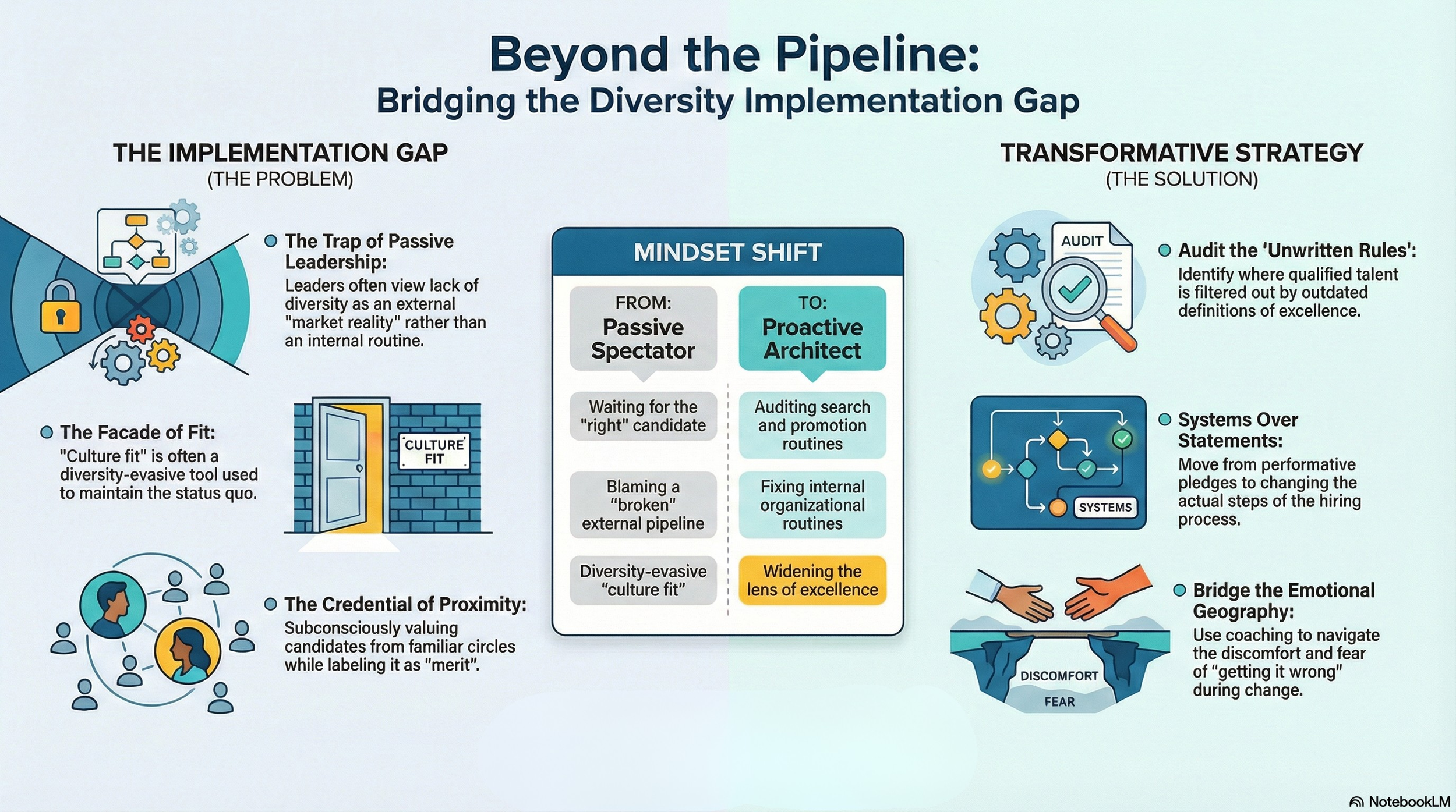
As a leader, you’ve likely heard—or even said—the phrase: "We’d love to diversify our team, but the pipeline just isn’t there."
It is one of the most common frustrations in the corporate, research, and creative worlds. You have the mission statement, the budget, and the desire to change, yet the demographics of your leadership and senior staff remain stagnant. It feels like an external problem—a market reality that you simply have to wait out.
But my research into organizational change suggests something different. What we often call a Pipeline Problem is actually an Implementation Gap.
The Trap of Passive Leadership
In my research on high-stakes organizations, I found that many leaders fall into the trap of normalizing overrepresentation. They view the lack of diversity as a natural, external phenomenon—like the weather—rather than a result of internal routines.
When we view the pipeline as broken outside of our doors, we inadvertently give ourselves permission to be passive. We wait for the right candidate to appear, and when they don't, we fall back on old hiring habits, calling it a matter of excellence or culture fit.
The Implementation Gap: Where Strategy Fails
The gap exists between your Strategic Plan (what you say you want) and your Organizational Routines (how you actually hire, promote, and evaluate).
My research shows that unwritten rules often govern these routines. For example:
The Credential of Proximity: Leaders subconsciously value candidates who come from the same circles or backgrounds as their current team, labeling it merit.
The Facade of Fit: Culture fit often becomes a diversity-evasive way to maintain the status quo.
Turning the Problem into an Opportunity
The good news? If the problem is internal, the solution is within your control. This isn't about lowering the bar; it's about widening the lens through which you view excellence.
At Transformative Organizational Strategy, I help change-ready leaders move from a passive stance to a proactive one through three specific shifts:
Audit the Unwritten Rules: TOS looks at your search and promotion routines to find where qualified, diverse talent is being filtered out by outdated definitions of fit.
Move Beyond Performative Pledges: TOS helps you stop making statements and start making systems. This means changing the actual steps of your hiring process, not just the language in the job post.
Bridge the Emotional Geography: Leading change is uncomfortable. TOS provides the coaching necessary to navigate the complex emotions—like the fear of getting it wrong—that often stall leadership action.
The Bottom Line
The pipeline isn't a fixed tunnel; it’s a system we build every day. When you stop waiting for the pipeline to fix itself and start looking at your own organizational routines, you stop being a spectator to change and start being the architect of it.
Read more about the research behind this Case Study:
Are you ready to bridge the gap?